Jellyfish Are "Exploding" in Numbers Here This Summer, Local Officials Warn
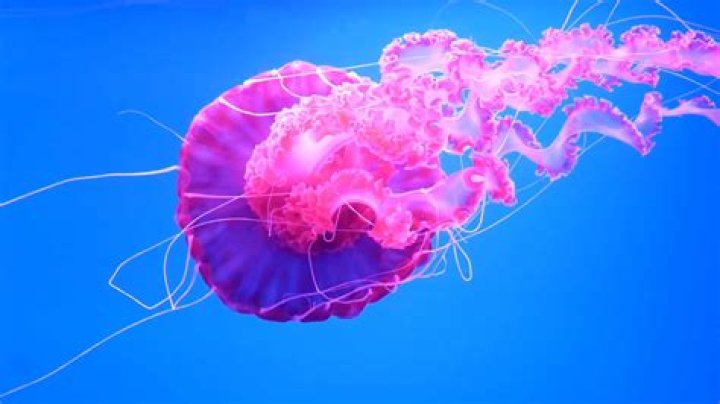
As temperatures continue to rise across the country, many of us are heading to the beach to cool off. And while there's nothing like relaxing with your toes in the sand, the ocean can also be a bit risky if you're not careful. One common creature beachgoers fear is jellyfish and rightfully so: There are around 150 million reported cases of jellyfish stings each year worldwide, according to a study published in the Journal of Travel Medicine. Unbelievably, there are more than 2,000 different species of jellyfish in the ocean. This year, sea nettle jellyfish in particular have made their way into several unlikely spots, and now, one state is seeing a startling surge, local officials warn. Read on to find out where swimmers should especially watch out.
RELATED: If You Notice This in a Hot Tub, Don't Go In, CDC Says.
There's an "exploding" population of jellyfish in Rhode Island.
The Rhode Island Department of Health and the Rhode Island Department of Environmental Management (DEM) recently announced that swimmers should be on the lookout for Atlantic sea nettle jellyfish in local waterways. It turns out, sea nettle jellyfish—which have mushroom-shaped bodies and dozens of silky tentacles—love the warm, briny waters of Rhode Island's ponds.
"There has been a high abundance of Atlantic sea nettle jellyfish in Ninigret and Green Hill Ponds lately," Katie Rodrigue, a marine biologist with the Rhode Island DEM, said in a statement. "Their population in the ponds has been exploding over the last month or so, probably as water temperatures have increased, and last week we observed thousands of them in the western section of Ninigret Pond along the East Beach side."
RELATED: Never Go in the Ocean If You Notice This, Experts Warn.
Jellyfish are likely to be found on docks and jetties.
Researchers say it's unclear why their numbers have exploded this summer, but they're hopeful that the jellyfish population will decline as temperatures cool. Paul Bologna, director of the Marine Biology and Coastal Sciences Program at Montclair State University in New Jersey, told the Providence Journal that sea nettles tend to proliferate among artificial structures like docks and jetties because they like to have something to attach to. When they're near each other, they're able to clone at a much faster rate.
"We're never going to get rid of them, but if we disrupt that, there will be fewer," he said.
Always treat a jellyfish sting right away.
Jellyfish stings can be painful, but for the most part, they're not life-threatening. In fact, experts at the University of Florida Health say swimmers are more likely to die from panicking and drowning after being stung by a jellyfish than from the sting itself.
Still, it's important to treat stings as quickly as possible. To do so, remove the stinger with tweezers or a gloved hand but avoid scraping the tentacles if possible. Experts then recommend rinsing the sting site with vinegar for at least 30 seconds. "Folks who plan on recreating in the coastal ponds this summer are encouraged to carry a first-aid kit with vinegar in case of a jellyfish encounter," the Rhode Island DEM says. However, if vinegar isn't readily available, you can rinse with salt water or a storebought anti-sting spray.
Once the skin has been rinsed, the DEM recommends applying a heat pack to the affected area and treating any itching or irritation with calamine lotion. As always, if symptoms don't improve, seek medical attention.
RELATED:For more up-to-date information, sign up for our daily newsletter.
Don't believe the myth about urine and jellyfish.
Contrary to popular belief, urinating on a jellyfish sting doesn't really work, and may worsen the sting, according to the Cleveland Clinic. That's because urine can actually trigger an additional burst of venom. The Virginia Institute of Marine Science explains that jellyfish tentacles are covered with stinging cells called nematocysts that act as a protective coating. If triggered, those nematocysts can release a tiny venom-coated barb into the jellyfish's target, which can be activated by urine.
Jellyfish tentacles can also continue to sting even after they've been detached from the animal's body, which is why it's imperative to be careful as you're treating a sting. Any extra contact with the tentacle can cause additional bursts of venom to be released out of the nematocysts and into your skin. So, whatever you do, avoid rubbing or touching the sting too much.
RELATED: If You're Going to the Beach, Never Bring This in the Water, Experts Warn.
Filed UnderAnimals • NewsRead This NextNever Wear This in Your Yard This Summer
Stay away from this kind of clothing when heading outside as temperatures rise.June 16, 2021If You Live in These States, Never Go in the Ocean When It's Calm
These three states are most likely to experience a potentially deadly aquatic phenomenon this summer.June 26, 2021The Smart Man's Guide to Spotting Counterfeit Wine
That $2,000 bottle of Bourdeaux might be worth $20. Here’s how to be sure it’s the real thing.April 13, 2017The 5 Best Light-Bodied Red Wines for Extending Your Summer
Don't let September ruin a killer party. August 25, 201717 Insanely Cool New Luxury Bicycles for Spring
Meet the bikes that cost more than a car.March 31, 2017Best Life Essentials
You deserve the best. Live life to the fullest with these ultimate essentials.October 21, 2016This Is the Safest Way to Store Meat
Don't let that filet set you up for food poisoning. February 7, 2018Here Are the 10 Wealthiest Cryptocurrency Millionaires Under 40
Including one guy who is only 24 years-old!February 7, 2018This Is the Safest Way to Clean Your Floors
Keep your floors clean and looking brand new with this easy tip. February 8, 201815 Things Your Real Estate Agent Won't Tell You
These are sure to shock even the most intrepid homebuyers. February 14, 2018